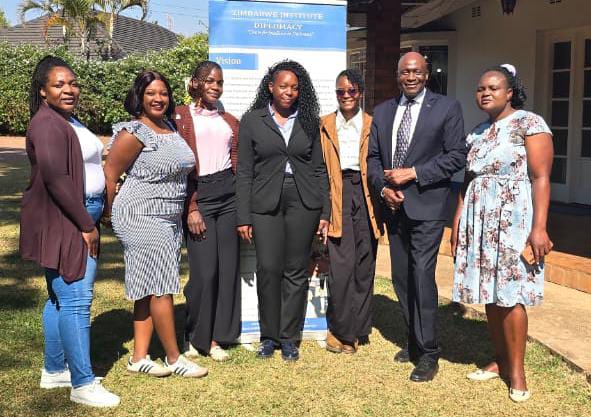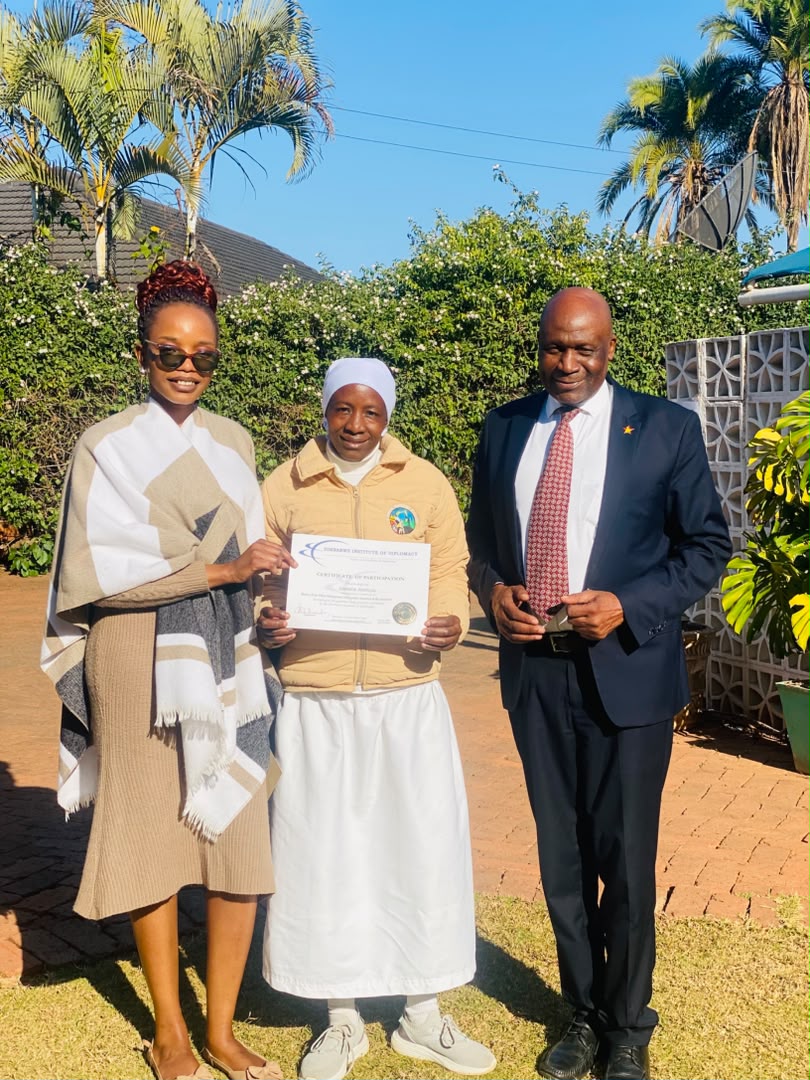
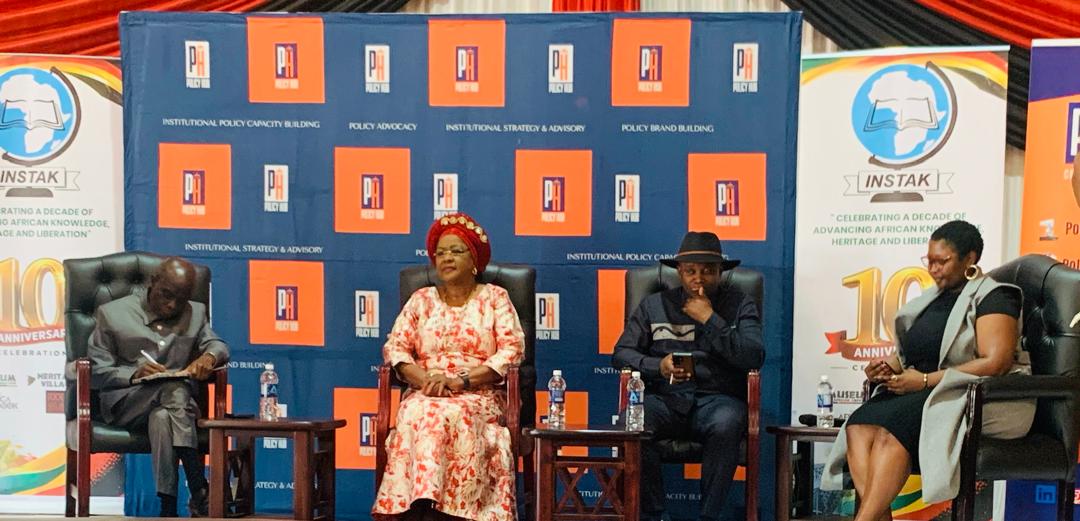
The Zimbabwe Institute of Diplomacy was privileged to join diplomats, scholars and civic leaders at the INSTAK 10th Public Lecture at Heritage Village Harare. Convened by CEO Ambassador Kwame T. Muzawazi in partnership with Policy Hub. Bringing together leading voices from across the continent, the event challenged participants to confront one of Africa’s most pressing questions: Who gets to define Africa’s story in an increasingly complex global order?
The Guest Lecturer was the renowned Pan-Africanist Nathalie Yamb, the Founder and Chief Executive of the Black Institute. Among the panellists were Ambassador Dr. Arikana Chihombori-Quao, Ambassador Kwame Muzawazi INSTAK’s Chief Executive and Baffour Ankomah a Ghanaian Pan Africanist Journalist. Together, they examined the intersection of sovereignty, development and Africa’s place within international institutions.
Nathalie Yamb delivered a compelling critique of modern systems of influence, arguing that foreign aid programmes, international institutions and sanctions have often advanced external geopolitical interests ahead of Africa’s development priorities. She emphasised that the true measure of governance is not ideology, but whether citizens enjoy food security, shelter and the dignity of a decent life.
One of the lecture’s most memorable moments was the story of a Nigerian man who reportedly entered a London museum carrying a toolbox to retrieve stolen Benin Bronzes. Whether viewed literally or symbolically, the story underscored a powerful reality: much of Africa’s cultural heritage remains outside the continent, disconnected from the communities to which it belongs.
The discussion also turned inward. Zimbabwe Institute of Diplomacy Chairperson and Principal Lecturer, Ambassador V.A. Chikanda, challenged participants to recognise that Africa’s greatest obstacle is not only political or economic, but psychological. He argued that the continent must liberate itself from mental dependency, reject the search for external validation and confidently shape its own future. Ambassador Chikanda observed that when Africa constantly frames its discourse around neo-colonialism, imperialism and historical exploitation by former colonial powers, it risks becoming apologetic and inadvertently elevating its former masters to the centre of Africa’s own narrative. While acknowledging the realities and enduring legacies of colonialism, he urged African leaders and institutions to shift their focus from grievance to strategy, from rhetoric to action and from dependency to self-determination.
He further emphasised that the era of confrontational diplomacy has given way to one that demands strategic engagement, quiet confidence and calculated statecraft. Rather than conducting diplomacy through social media platforms, public declarations or emotional exchanges, Africa must develop and execute long-term strategies with discipline and purpose. Citing Zimbabwe’s foreign policy principle of being “a friend to all and an enemy to none,” Ambassador Chikanda argued that constructive engagement, pragmatic partnerships and strategic national interests should guide the continent’s international relations. He concluded by noting that the unprecedented speed of technological advancement, the emergence of artificial intelligence and the rise of a new generation of Africans require fresh approaches to diplomacy and international affairs. In an increasingly interconnected and globalised world, Africa must embrace innovative thinking, strategic diplomacy and future-oriented leadership if it is to shape, rather than merely respond to, the international order.
While colonial legacies continue to shape global power relations, they cannot explain every challenge confronting Africa. Weak institutions, corruption, brain drain, poor procurement systems and limited investment in research and innovation require African-led solutions. Likewise, regional organisations such as the African Union must move beyond declarations to consistent implementation if they are to command credibility and influence. Africa can also learn selectively from experiences such as China’s infrastructure-driven development and Europe’s regional integration, while designing institutions that reflect its own realities and aspirations. The lecture ultimately reaffirmed that reclaiming the African narrative is about far more than recovering artefacts or asserting sovereignty. It requires accountable leadership, resilient institutions, investment in African knowledge and innovation and the confidence to define Africa’s future on African terms.
The Zimbabwe Institute of Diplomacy (ZID) expresses its sincere appreciation to the Institute of African Knowledge (INTSAK) for its unwavering commitment to the research, documentation and dissemination of knowledge about Africa and its people in pursuit of a renewed African legacy in an increasingly globalised world. Through its work, INTSAK plays a vital role in preserving Africa’s liberation heritage, promoting African intellectual sovereignty and reshaping global narratives by ensuring that Africa’s history, achievements and aspirations are articulated from an authentically African perspective.